The Pekes–Pollicles rivalry
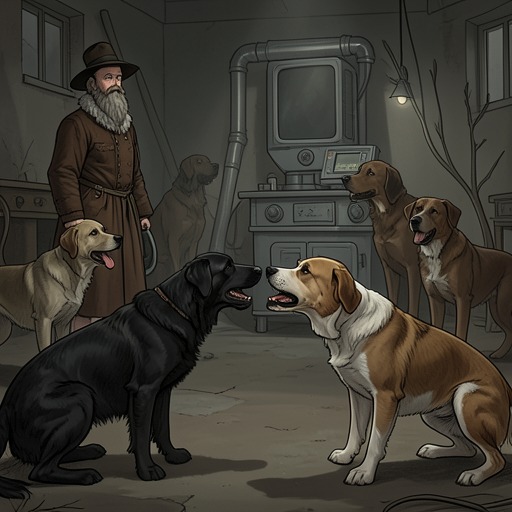
Old Possum's Book of Practical CatsThe Pekes–Pollicles rivalry is a habitual enmity rather than a conflict confined to one decisive battle: the account calls the two groups proud, implacable foes and says the pattern recurs wherever one goes. A chance meeting between a Peke and a Pollicle turns that broad reputation into a compact street scene. The encounter follows the rivalry’s familiar logic: neither side yields, both display hostility, and the resulting noise makes the dispute seem larger than the two dogs who began it. The Great Rumpuscat ends the immediate confrontation not by joining either side, but by frightening both into flight.
A Recurring Enmity
The rivalry is introduced as a settled condition between the Pekes and the Pollicles. Its defining qualities are pride and implacability: the dogs are not depicted as opponents brought together by a particular grievance, nor is a cause offered for their antagonism. Instead, the account presents their opposition as something widely known and persistently repeated. The suggestion that the same pattern holds wherever one goes makes this conflict seem less like an isolated quarrel than a portable social expectation, ready to reappear wherever members of the two groups encounter one another.
That general statement gives the street episode its shape. The meeting does not need a new insult or an elaborate dispute to ignite; the identities of the two dogs are enough to establish tension. The rivalry operates almost as a script, and the dogs’ actions follow its opening beats: they stop, size one another up, and refuse to make the first move that would look like retreat. In this way, the scene gives physical form to the reputation established at the outset, while showing how an apparently simple encounter can reactivate a much broader antagonism.
The Street Standoff
The immediate encounter takes place when a Peke and a Pollicle happen to meet on a street with no one else about. Their first response is carefully poised between aggression and withdrawal. They do not advance, but they do not exactly retreat either. Instead, they glare at one another and scrape their hind feet. The details make the rivalry visible as a contest of stance: each dog holds position and signals hostility, while neither yet commits to a direct charge.
The hesitation is not a resolution. It is a charged pause, in which refusing to give ground becomes part of the conflict. The dogs’ gestures preserve the possibility of escalation while delaying it; the encounter can still be read as a standoff, but its tension is already bodily and public. The empty street matters to the scene because the initial confrontation belongs to the two rivals alone. Only afterward does their display swell into a disturbance that draws the neighbourhood into alarm.
From Two Dogs to a Wider Disturbance
The account broadens the scale of the rivalry through sound. The Pollicles are described as liking a terrible din, and the dogs’ grumbling and wheezing turns the encounter into an uproar. That description gives their hostility a collective character: the street meeting is between one Peke and one Pollicle, but it evokes the noisy, combative identity assigned to the groups more generally. The dispute’s effects also extend beyond its participants. Some neighbours become so frightened that they start calling the Fire Brigade, showing how quickly the dogs’ confrontation exceeds the bounds of their original standoff.
The scene thus distinguishes between the small number of dogs directly facing one another and the larger impression their noise creates. The rivalry sounds like a much broader disturbance, even though the account began with a single pair meeting by chance. This contrast gives the episode its comic escalation: a tense but stationary face-off grows loud enough to alarm the neighbours, yet it does not culminate in a described fight between the two sides. The racket magnifies the threat; the eventual scattering, rather than a victory by either rival group, resolves the immediate scene.
The Great Rumpuscat’s Intervention
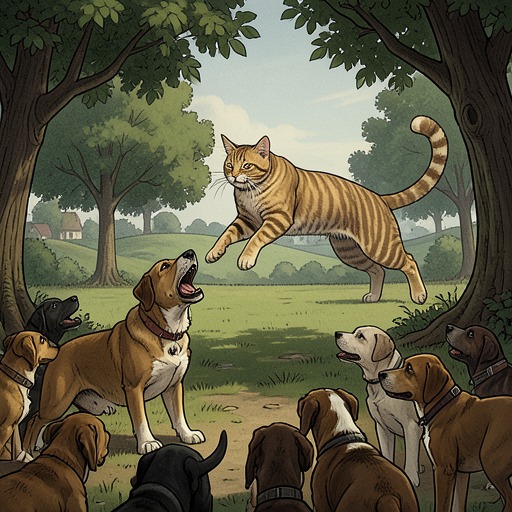
The reversal comes from a basement flat. The Great Rumpuscat stalks out, his eyes blazing and his yawn presenting an alarming display of jaws. He looks out through the bars of the area, and the combined impression of his glare and yawning makes him seem fiercer and hairier than anything the Pekes and Pollicles wish to face. The account makes this appearance the decisive interruption: the rivals, who had held their ground against one another, quickly take warning from the cat.
The Great Rumpuscat does not need to attack either group. He looks at the sky and makes a great leap; at that, every one of the dogs scatters like sheep. The reversal is striking because the rivalry has been framed as enduring and implacable, yet in this encounter it proves vulnerable to a threat from outside its own contest. The dogs who had refused to advance or retreat in front of one another retreat together when confronted by the cat. The poem does not describe the intervention as a lasting change in their relationship, only as the cause of their immediate flight.
Aftermath and Narrative Significance
When the police dog returns to his beat, not a single dog remains in the street. The empty street closes the episode as neatly as the chance meeting opened it: the rivalry had filled the space with wary gestures and noise, but the intervention leaves no combatants there for the returning officer to find. The neighbours’ alarm and the police dog’s return frame the disturbance as a public nuisance as well as a private contest, though the account gives no further consequence beyond the dogs’ disappearance.
The episode’s outcome neither awards victory to the Pekes nor to the Pollicles, and it does not establish a reconciliation. Instead, it briefly suspends their antagonism by replacing their mutual confrontation with a common reason to flee. That distinction preserves the account’s opening claim that their enmity is recurrent: the particular street disturbance ends, but nothing in the ending suggests that the underlying rivalry has been settled. Its comic force comes from the contrast between the dogs’ proud, persistent opposition and the sudden ease with which the Great Rumpuscat clears the street.